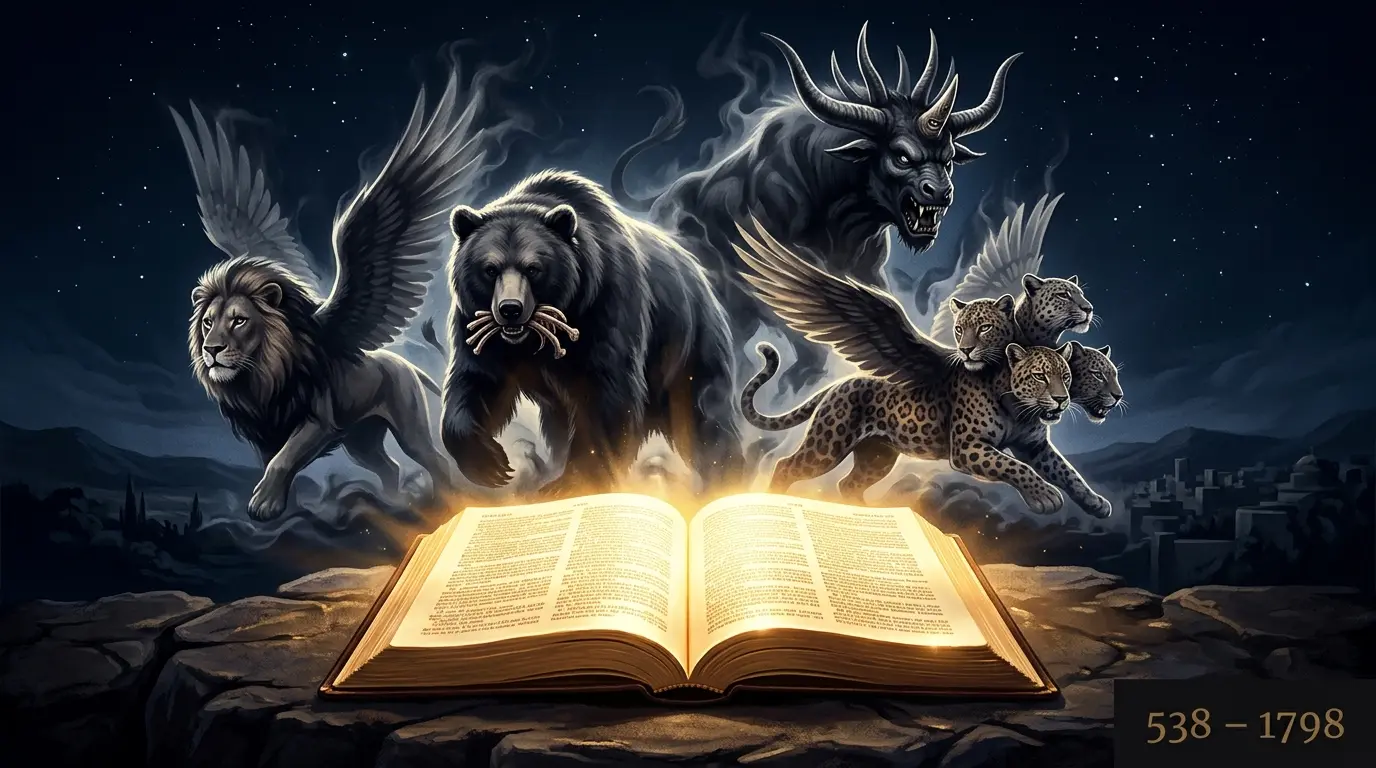
Some of you won’t enjoy this post. Read to the end anyway, and you’ll have enough information to decide for yourself what to believe, rather than taking anyone’s word for it, mine included.
A note on tone before we start. This is a study of a prophecy and a religious system, not of individual Catholics, many of whom love Jesus sincerely. I also know you’ve been curious about these two books for a while, so I promise to keep the symbolism to a minimum. (The beasts, unfortunately, did not get the memo.)
All Scripture quotations are from the New King James Version (NKJV).
The World They Didn’t Want You to See
Some churches teach that only the priest or pastor is capable of understanding the Bible. The Bible teaches no such thing. It praises ordinary people who checked everything for themselves:
These were more fair-minded than those in Thessalonica, in that they received the word with all readiness, and searched the Scriptures daily to find out whether these things were so.
(Acts 17:11)
And it blesses the readers of Revelation:
Blessed is he who reads and those who hear the words of this prophecy, and keep those things which are written in it; for the time is near.
(Revelation 1:3)
My hope is that you’ll see how simple the Bible is when it explains itself, and that you’ll be curious enough to keep studying on your own.
The Foundation: Four Beasts, Four Kingdoms
Daniel 7 opens with a strange vision:
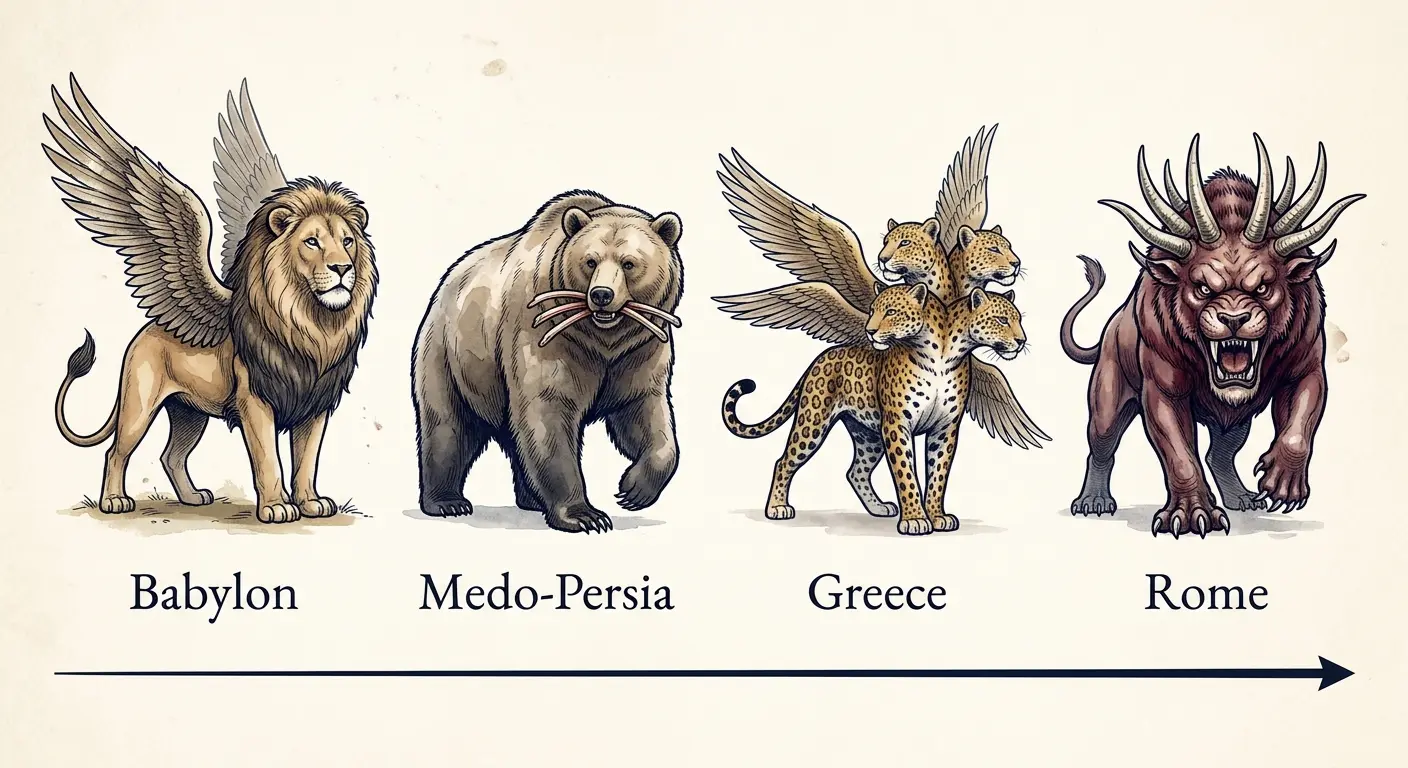
And four great beasts came up from the sea, each different from the other. The first was like a lion, and had eagle’s wings.
(Daniel 7:3–4)
Lions don’t have wings, which is our first clue that this is not a nature documentary.
Happily, the Bible interprets its own symbols:
Those great beasts, which are four, are four kings which arise out of the earth.
(Daniel 7:17)
And:
The fourth beast shall be a fourth kingdom on earth, which shall be different from all other kingdoms.
(Daniel 7:23)
A beast is simply a king and his kingdom, and its odd features describe the character of that kingdom.
The four kingdoms, in order, are Babylon, Medo-Persia, Greece, and Rome. They matter because they are the powers that directly touched God’s people. Israel was taken captive to Babylon, and Daniel was among the captives. Babylon fell to Medo-Persia, Medo-Persia fell to Greece under Alexander the Great, and Greece fell to Rome, the empire ruling in Jesus’ day.
Quick recap: Daniel saw four beasts. They represent four kingdoms: Babylon, Medo-Persia, Greece, and Rome. All four are tied to the story of God’s people.
Why bother with ancient empires? Because Revelation speaks in Daniel’s symbols. Revelation covers events in our own time and the future, and without Daniel we can’t tell what a beast is, who the beast is, or what its mark is. You can’t avoid a mark you can’t identify, so anyone explaining the mark of the beast without going to Daniel is working without a map. These kingdoms give us a timeline for tracing the events meant for our day, and the widespread disinterest in studying these two books is not inspired by the Spirit of God.
The Fourth Beast and Its Little Horn
The fourth beast “was different from all the beasts that were before it, and it had ten horns” (Daniel 7:7). The ten horns are “ten kings who shall arise from this kingdom. And another shall rise after them; he shall be different from the first ones, and shall subdue three kings” (Daniel 7:24). In other words, ten nations rose from the ruins of Rome, and among them a “little horn” (Daniel 7:8) arose and uprooted three.
Scripture gives ten identifying marks of this power:
Its claims: “a mouth speaking great things and blasphemies” (Revelation 13:1,5,6; see also Daniel 7:8, 11, 20, 25; 2 Thessalonians 2:4; Revelation 13:1, 6).
Its inherited authority: “The dragon gave him his power, his throne, and great authority” (Revelation 13:2).
Its rise: it “shall subdue three kings” (Daniel 7:24; see also 7:8, 20).
Its inherited characteristics: “like a leopard… feet were like the feet of a bear… mouth like the mouth of a lion” (Revelation 13:2; see Daniel 7:12).
Its persecution: it “shall persecute the saints of the Most High” (Daniel 7:25; see also 7:21; Revelation 13:7).
Its number: “His number is 666” (Revelation 13:18).
Its doctrine: it denies that Jesus Christ has come in the flesh (1 John 4:3; 2 John 7).
Its tampering with God’s law: it “shall intend to change times and law” (Daniel 7:25).
Its duration: “a time and times and half a time” (Daniel 7:25; 12:7; Revelation 12:14), “forty-two months” (Revelation 11:2; 13:5), and “one thousand two hundred and sixty days” (Revelation 11:3; 12:6).
Its wound and recovery: “as if it had been mortally wounded… his deadly wound was healed” (Revelation 13:3).
The little horn of Daniel 7 and the beast of Revelation 13, the one carrying 666, are the same power. This is the historicist reading held by the Protestant Reformers and by the Seventh-day Adventist Church: the little horn points to the papacy of the Roman Catholic Church. That’s a weighty claim, so let’s test it against each mark.
Mark 1: A Man Who Sits in God’s Temple
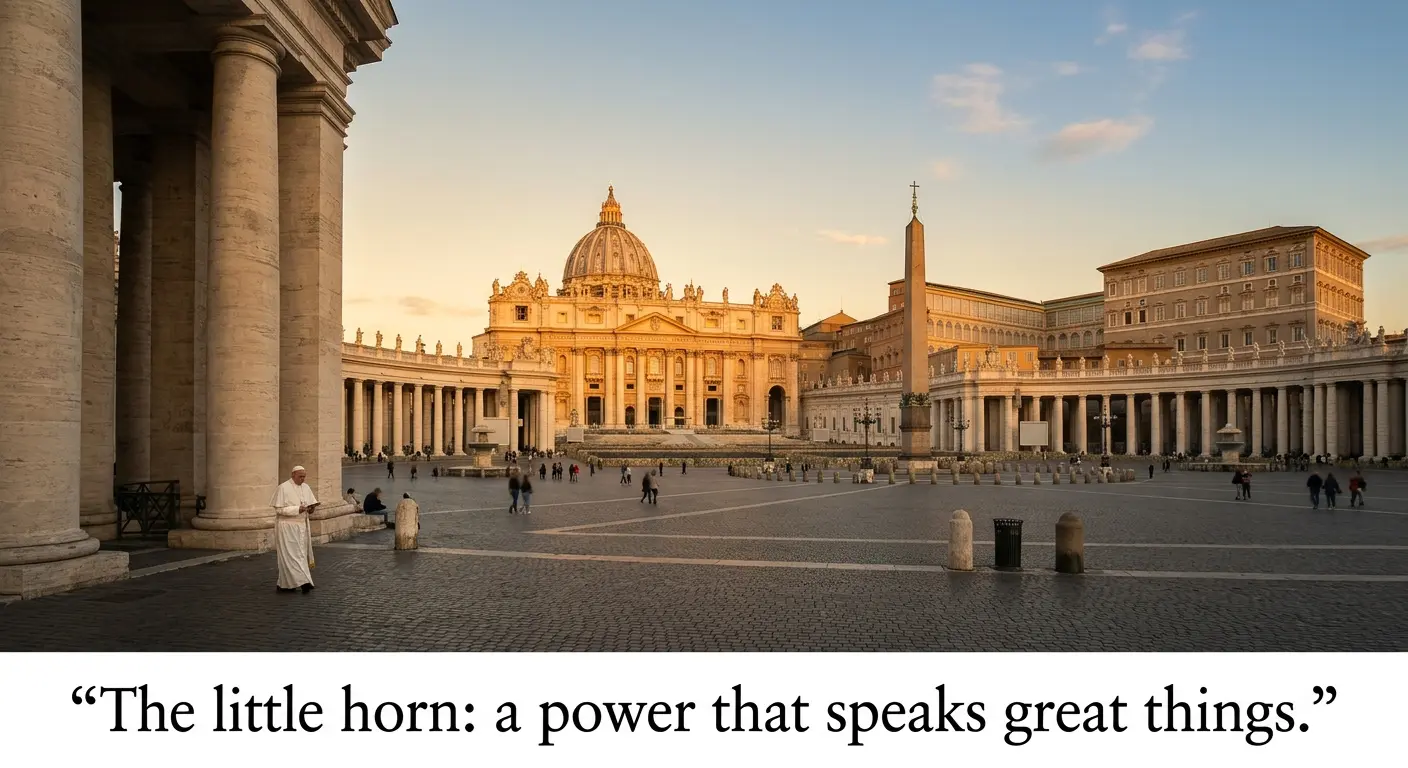
The Bible gives two definitions of blasphemy. The first is a man making himself God:
…because You, being a Man, make Yourself God.
(John 10:33)
The second is claiming the power to forgive sins, which belongs to God alone:
Who can forgive sins but God alone?
(Luke 5:21)
The papacy’s own writers have made claims that fit both:
Thou art another God on earth.
— Christopher Marcellus, Fifth Lateran Council, 4th session (said of the pope)
We hold upon this earth the place of God Almighty.
— Pope Leo XIII, encyclical on the reunion of Christendom
All names which in the Scriptures are applied to Christ...all the same names are applied to the Pope.
—Robert Bellarmine, Disputationes de Controversiis, Tom. 2
…the pope is crowned with a triple crown, as king of heaven and of earth and of the lower regions.
— Lucius Ferraris, Prompta Bibliotheca, “Papa,” art. 2
The Methodist commentator Adam Clarke, writing on Daniel 7:25, listed the same pattern: assumed infallibility, forgiving sins, opening and shutting heaven, standing above kings, freeing nations from their oaths, and selling indulgences. He called it the worst of blasphemies.
Even the title “pope” means “papa,” or father, a title Christ reserves for God:
Do not call anyone on earth your father; for One is your Father, He who is in heaven.
(Matthew 23:9)
Paul describes the same power:
…the man of sin is revealed, the son of perdition, who opposes and exalts himself above all that is called God or that is worshiped, so that he sits as God in the temple of God, showing himself that he is God.
(2 Thessalonians 2:3–4)
Mark 2: Power From the Dragon
Who is the dragon?
So the great dragon was cast out, that serpent of old, called the Devil and Satan, who deceives the whole world.
(Revelation 12:9)
In the wilderness, the devil “showed Him all the kingdoms of the world and their glory. And he said to Him, ‘All these things I will give You if You will fall down and worship me’” (Matthew 4:8–9). Jesus refused. Our reading is that the same offer was later made to the bishop of Rome, and this time it succeeded. Notice the contrast. The Savior had “nowhere to lay His head” (Luke 9:58), while the papacy claims authority over presidents, kings, and every other earthly ruler.
Here is how it happened. Pagan Rome tried to crush Christianity through persecution, but the more Christians it killed, the more people converted. So the strategy changed from persecution to infiltration.
The emperor Constantine, who wanted to unite pagans and Christians, stopped the persecution and later joined the church. It was largely a political move to win as many supporters as possible. Working with the bishops of Rome, he agreed to a compromise: pagan rituals and ceremonies were welcomed in, only under Christian names. The adoration of saints is one example of what grew from this. When Constantine moved his capital to Byzantium, renaming it Constantinople, he gave the palace in Rome to the bishop of Rome. That laid the foundation for the papal seat, though it would not be firmly established until later. As the historian Adolf Harnack put it, the pope is “Caesar’s successor” (What Is Christianity?, 1903, p. 270).
Mark 3: Three Kings Subdued
In A.D. 476 Rome’s power passed to ten nations, the ten horns of the fourth beast. Three of them, the Heruli, the Vandals, and the Ostrogoths, refused to recognize the bishop of Rome as head of the church and were uprooted. They are the three horns “plucked out by the roots” to make room for the little horn (Daniel 7:8).
The bishop of Rome did not gain full power the moment he inherited the seat in Constantine’s day. In A.D. 533 the emperor Justinian issued a decree recognizing him as “head of all the holy churches,” but sovereignty remained incomplete while the Ostrogoths held power in Rome. In A.D. 538 the Ostrogoths, the last of the three, were decisively defeated. The bishop of Rome, now with unchallenged political and ecclesiastical authority, was the most powerful man in the West. The church had become a kingdom, with the pope as its king.
Mark 4: A Little of Every Kingdom
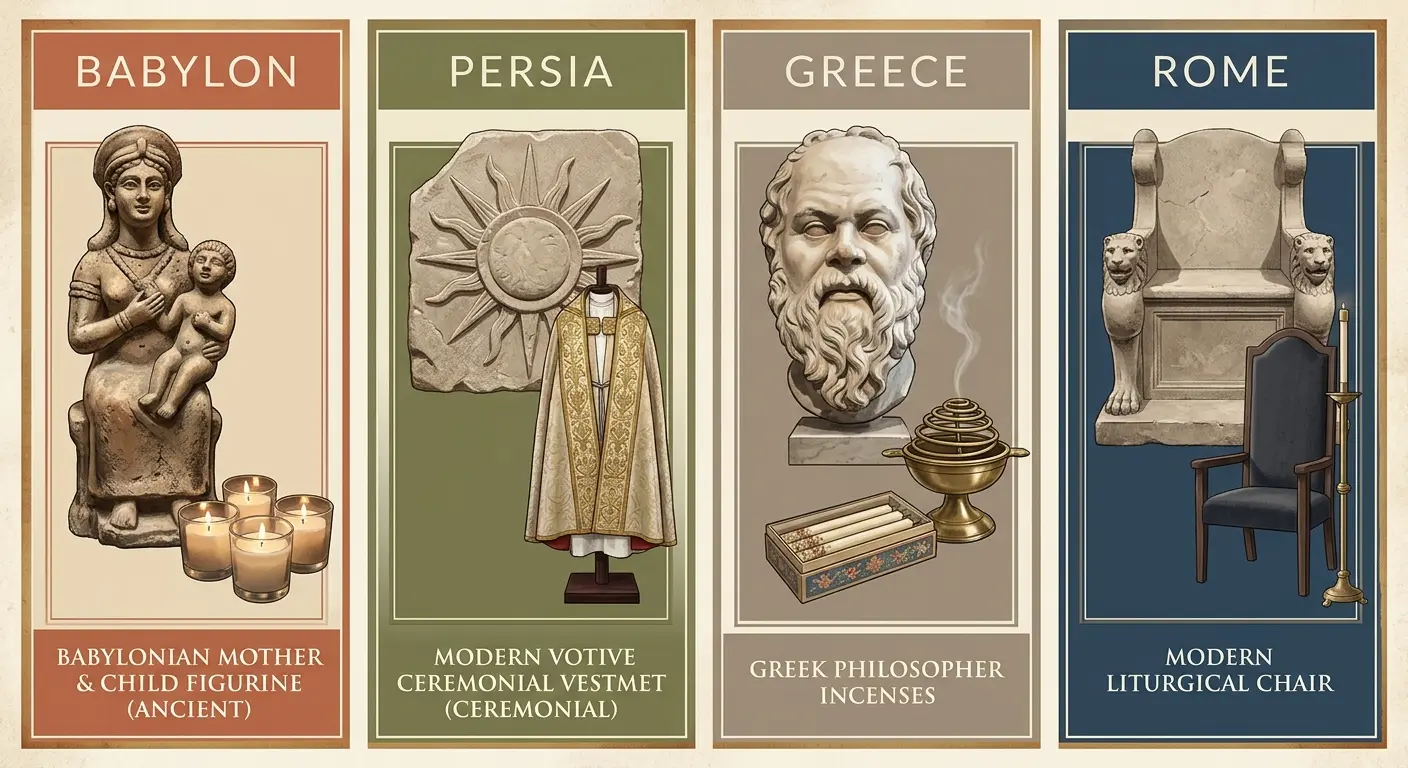
The beast was “like a leopard… feet like the feet of a bear… mouth like the mouth of a lion” (Revelation 13:2), meaning it carries features of Greece, Medo-Persia, and Babylon. These survive in the papacy. The priesthood and sacramental ritual echo Babylonian cults. The worship of a virgin mother-goddess also came from ancient Babylon. Persian sun worship (Mithraism) is preserved in holidays and customs of the catholic people. Greek Gnostic philosophy entered through the church fathers and early catholic councils.
This isn’t only an outside accusation. Cardinal John Henry Newman, in his Essay on the Development of Christian Doctrine (1920 ed., p. 373), openly listed practices “of pagan origin” that were brought in to make the new religion attractive to the heathen: temples dedicated to saints, incense, candles, holy water, holy days, processions, priestly vestments, the ring in marriage, images, and the ecclesiastical chant.
Mark 5: Persecution of God’s People
The little horn “was making war against the saints, and prevailing against them” (Daniel 7:21,25). In Revelation:
It was granted to him to make war with the saints and to overcome them.
(Revelation 13:7)
The history is painful. Brief Bible Readings for Busy People, estimates more than one hundred million martyrs over the centuries and gives these examples: about a million Waldenses and Albigenses killed in a crusade proclaimed by Pope Innocent III in 1208; some 900,000 destroyed between 1540 and 1580 after the founding of the Jesuits; 150,000 killed by the Inquisition in thirty years; 50,000 executed in thirty-eight years after Charles V’s edict against Protestants; and 18,000 under the Duke of Alva in five and a half years. The pattern is documented. The historian W. E. H. Lecky concluded that Rome had shed more innocent blood than any other institution in history, a judgment he said no well-informed Protestant would question (History of the Rise and Influence of the Spirit of Rationalism in Europe, Vol. 2, p. 40).
Mark 6: The Number 666
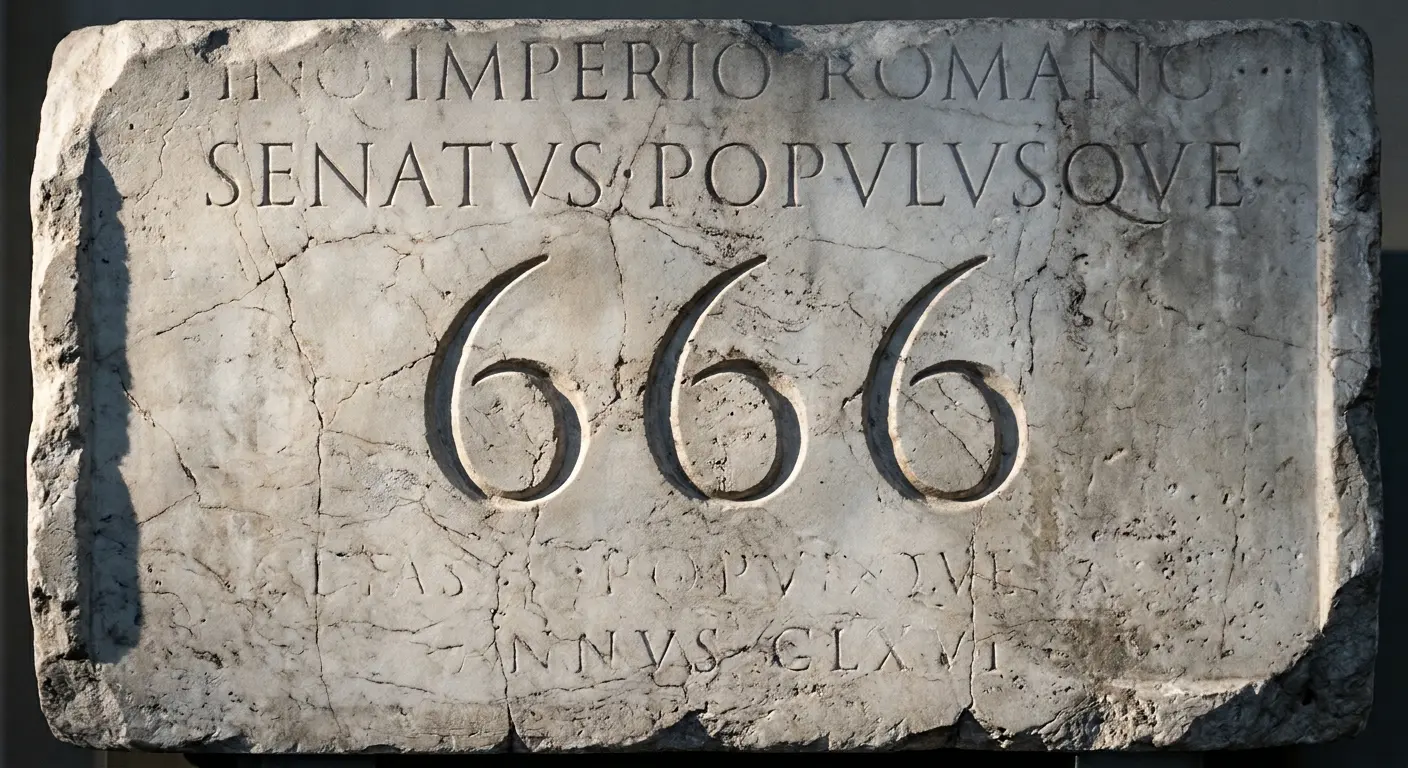
Here is wisdom. Let him who has understanding calculate the number of the beast, for it is the number of a man: His number is 666.
(Revelation 13:18)
Four facts stand out:
It is “the number of the beast” (13:18).
It is “the number of a man” (13:18).
It is “the number of his name” (13:17).
Anyone “who has understanding” can calculate it (13:18).
The Catholic Douay Bible agrees in its note on this verse: “The numeral letters of his name shall make up this number.” So all we need is the title. The Catholic weekly Our Sunday Visitor (April 18, 1915) said the letters inscribed on the pope’s miter are VICARIUS FILII DEI, Latin for “Vicar of the Son of God.” The title appears in Roman Catholic literature of high standing, including Ferraris’s Prompta Bibliotheca (“Papa”) and Cardinal Manning’s The Temporal Sovereignty of the Pope, which applies it to the pope eleven times.
Before Arabic numerals, letters carried number values. Using the Roman numerals you already know (I = 1, V or U = 5, X = 10, L = 50, C = 100, D = 500; every other letter = 0), the sum is simple, and no calculator or conspiracy wall is required:
VICARIUS: V 5 + I 1 + C 100 + A 0 + R 0 + I 1 + U 5 + S 0 = 112
FILII: F 0 + I 1 + L 50 + I 1 + I 1 = 53
DEI: D 500 + E 0 + I 1 = 501
Total: 112 + 53 + 501 = 666
Quick recap: The little horn is the pope of the Roman Catholic Church. The papal seat was firmly established in A.D. 538 when the Ostrogoths fell, and the church became a kingdom with the pope as king. 666 is not the mark of the beast. It is the number of the beast’s name, which we can calculate. The system persecuted those it labeled heretics, enforced religion on pain of death, and absorbed pagan ceremonies that have no foundation in the Bible.
Mark 7: Denying Christ Came in the Flesh
The apostle John, who also wrote Revelation, gave a test:
Every spirit that does not confess that Jesus Christ has come in the flesh is not of God. And this is the spirit of the Antichrist.
(1 John 4:3). See also 2 John 7
The Bible says Jesus came “in the likeness of sinful flesh” (Romans 8:3), and that “in all things He had to be made like His brethren, that He might be a merciful and faithful High Priest” (Hebrews 2:17). He can sympathize because He “was in all points tempted as we are, yet without sin” (Hebrews 4:15).
The Catholic doctrine of the immaculate conception (proclaimed in 1854), which teaches that Mary was preserved from sin’s inherited stain from the moment of conception, contradicts the scripture above. It places Christ’s humanity at a distance from our own, which makes it harder to say He was truly “touched with the feeling of our infirmities.” That, the Bible says, is Antichrist.
Mark 8: Changing God’s Law
He shall speak pompous words against the Most High, shall persecute the saints of the Most High, and shall intend to change times and law.
(Daniel 7:25)
Notice the target. This power opposes the Most High Himself, so the “times and law” it would change are God’s. The papacy has claimed that right. Ferraris wrote that the pope “can modify divine law,” since he acts “in the place of God upon earth” (Prompta Bibliotheca, “Papa,” art. 2).
The Ten Commandments (Exodus 20:3–17) are the one part of Scripture God both spoke with His own voice and wrote with His own hand: “tablets of stone, written with the finger of God” (Exodus 31:18). Compare them with what appears in Catholic catechisms:
The second commandment: “You shall not make for yourself a carved image—any likeness of anything that is in heaven above, or that is in the earth beneath, or that is in the water under the earth” (Exodus 20:4). Images are central to Catholic worship, and this commandment is left out of the catechism lists. To still reach ten, the tenth is split in two.
The fourth commandment: The only commandment tied to time is this one: “Remember the Sabbath day, to keep it holy. Six days you shall labor and do all your work, but the seventh day is the Sabbath of the LORD your God. In it you shall do no work” (Exodus 20:8–10).
The catechism itself says who moved the day. Peter Geiermann’s The Convert’s Catechism of Catholic Doctrine (1957 ed., p. 50) asks which day is the Sabbath, answers that it is Saturday, and then explains that Sunday is observed because the Catholic Church transferred the solemnity from Saturday to Sunday. The widespread neglect of God’s seventh-day Sabbath and the honoring of the first day came from papal authority rather than Scripture. The Bible’s test for any teaching is plain:
To the law and to the testimony! If they do not speak according to this word, it is because there is no light in them.
(Isaiah 8:20)
Mark 9: The 1260 Years
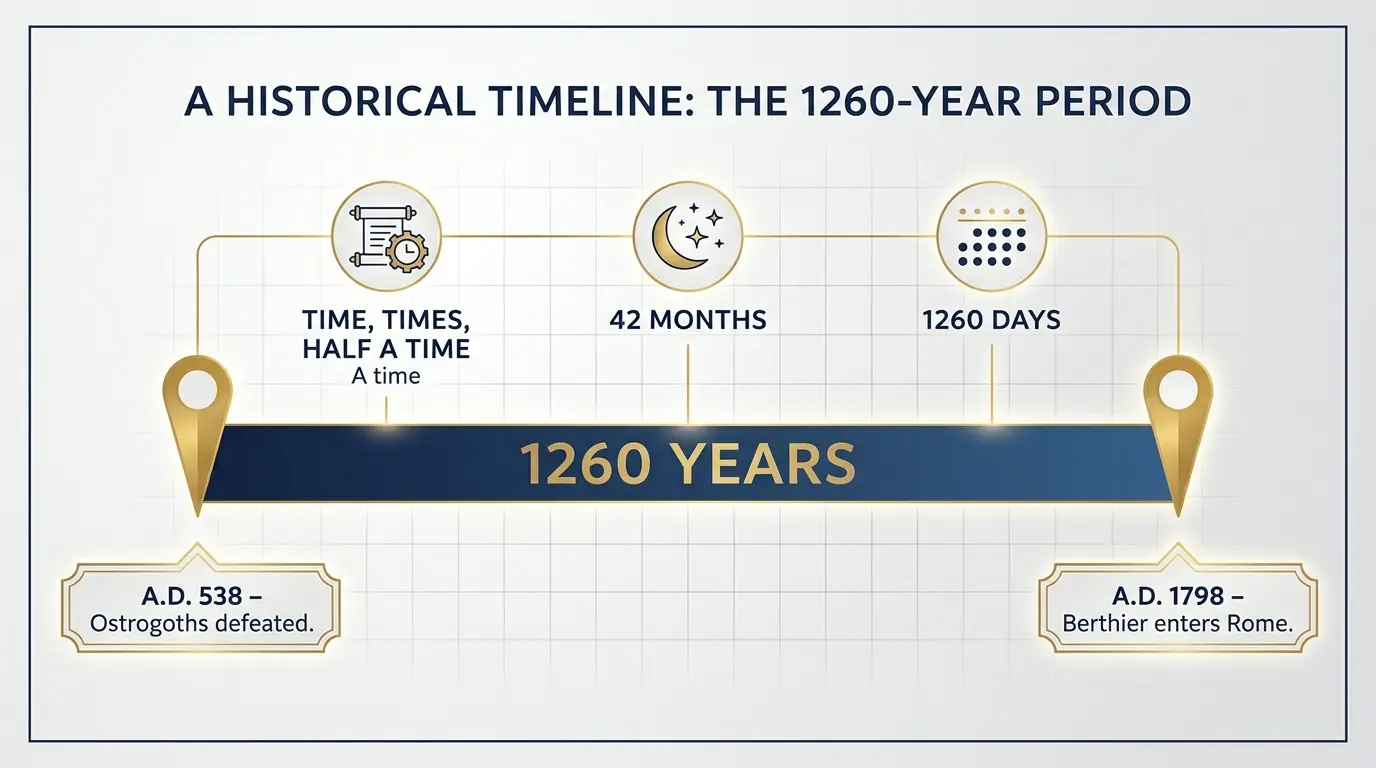
Three expressions describe the same period of papal supremacy:
“a time and times and half a time” (Daniel 7:25; 12:7; Revelation 12:14)
“forty-two months” (Revelation 11:2; 13:5)
“one thousand two hundred and sixty days” (Revelation 11:3; 12:6)
Do the math. A “time” is a year (see Daniel 4:16, “let seven times pass over him”), and a prophetic year has 360 days. In Aramaic, the original language of Daniel 7:25, “times” means two times. So 1 time (360) + 2 times (720) + half a time (180) = 1,260 days. And 42 months × 30 days = 1,260 days. With seven references in Scripture, the span is exact.
Convert it. The Bible supplies the scale, a day for a year: “for each day you shall bear your guilt one year” (Numbers 14:34), and “I have laid on you a day for each year” (Ezekiel 4:6). So 1,260 prophetic days = 1,260 literal years.
Place it. The period begins in A.D. 538, when the Ostrogoths were defeated, as covered above. A.D. 538 + 1,260 years = A.D. 1798. On February 10, 1798, during the French Revolution, Napoleon’s general Berthier entered Rome, proclaimed a republic, and took the pope prisoner. The pope died in exile in Valence, France, in 1799.
Mark 10: A Wound That Healed
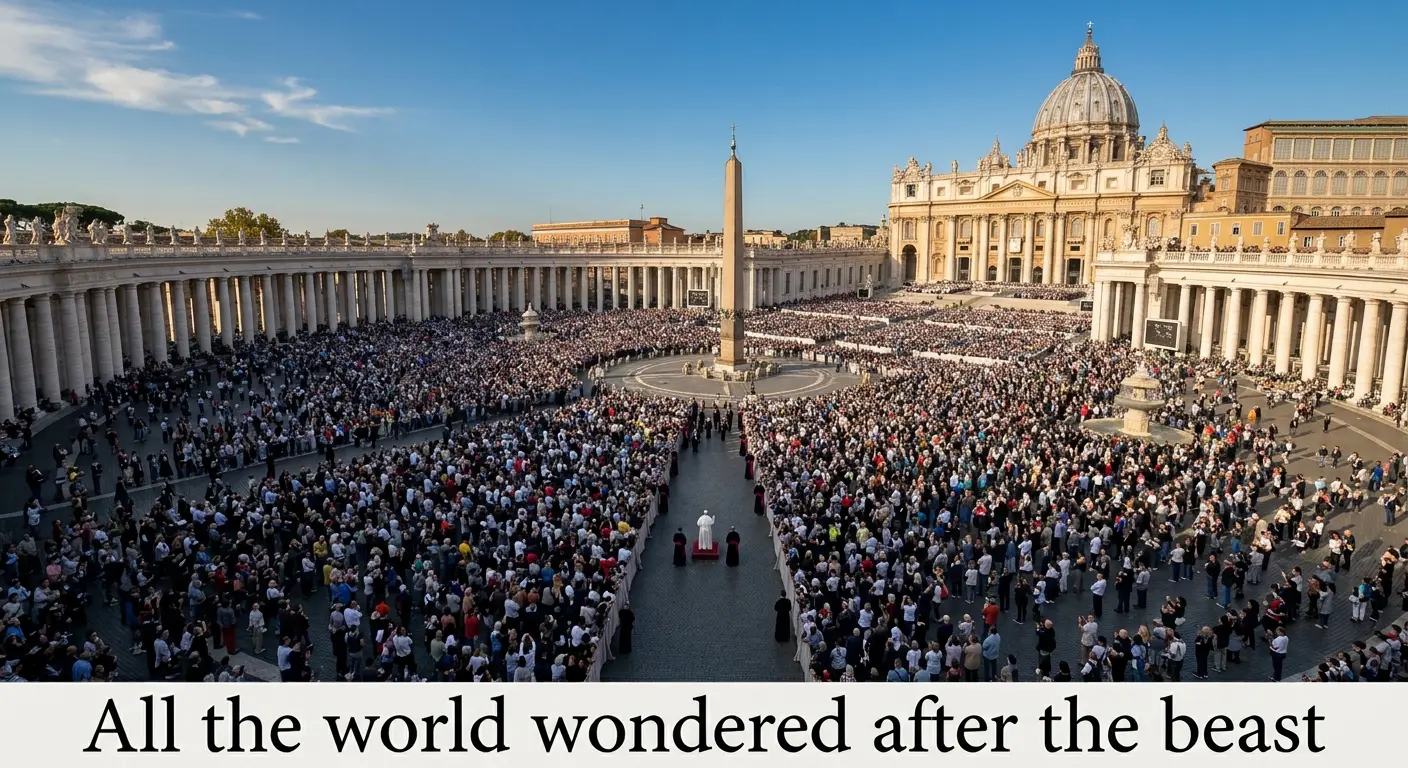
And I saw one of his heads as if it had been mortally wounded, and his deadly wound was healed. And all the world marveled and followed the beast.
(Revelation 13:3)
The blow of 1798 was the deadly wound, and it destroyed the papal structure, at least for a moment. In 1870 the Italian government took over the city of Rome. Then, in 1929, Cardinal Gasparri and Premier Mussolini signed the Lateran Treaty, returning political power to the papacy and recognizing Vatican City as an independent state with the pope as its sovereign. Religious and civil power were united in one office again.
The press saw it the same way. The Catholic Advocate of Australia (April 18, 1929) said the treaty would “heal a wound of 59 years.” The San Francisco Chronicle (February 12, 1929) ran the front-page headline “Heal Wound of Many Years.” The Associated Press described the signing as “healing the wound which has festered since 1870.” On March 9, 1929, the pope declared, “The peoples of the entire world are with us.” Today, there isn't a single person on earth who receives more publicity or has their movements followed as closely as the pope – presidents included.
Quick recap: The papacy teaches the immaculate conception, a doctrine which confirms the antichrist identification. It has attempted to change God’s law by omitting the second commandment, splitting the tenth, and moving the Sabbath to Sunday. It held supremacy for exactly 1,260 years (A.D. 538–1798), as prophesied. It suffered a deadly wound in 1798 when the pope was imprisoned, and the wound was healed in 1929.
The Downward Spiral
This apostasy did not happen overnight. As early as the first century, Paul warned:
For the mystery of lawlessness is already at work.
(2 Thessalonians 2:7)
Quietly at first, and then openly as it gained strength, error crept into the church. While paganism persecuted Christians, the church stayed humble and faithful. When persecution ceased and Christianity entered the courts and palaces, the church exchanged apostolic simplicity for pomp and substituted human traditions for God’s requirements. Constantine’s nominal conversion in the early fourth century was celebrated, yet the world walked into the church, and pagan doctrines, ceremonies, and superstitions were folded into Christian worship. The result was the “man of sin” of prophecy.
Satan once offered Christ the kingdoms of the world for worship, and Christ refused. The church, seeking the favor of the powerful, eventually accepted what Christ turned down. Here are the steps down:
Silencing the Word. Satan knew Scripture would expose his deceptions, so the Bible was restricted for centuries. People were forbidden to read or own it, and the clergy interpreted its teachings to sustain their pretentions. Christ answered every temptation with “It is written” (Matthew 4:4, 7, 10), and He said: “You search the Scriptures, for in them you think you have eternal life; and these are they which testify of Me” (John 5:39).
Penance and payment. People were taught to trust their own works to atone for sin: pilgrimages, penance, relics, shrines, and large payments to the church. Yet “by grace you have been saved through faith, and that not of yourselves; it is the gift of God, not of works, lest anyone should boast” (Ephesians 2:8–9).
Church forgeries. When some resisted papal supremacy, and the Bible offered no support for one man ruling all churches, monks produced forged ancient writings and “discovered” decrees that supposedly established papal authority from the earliest times.
Images and candles. Image worship spread. Candles burned before images, and prayers were offered to them, in spite of Exodus 20:4–5.
The claim of never erring. In the eleventh century Pope Gregory VII declared the Roman church had never erred and never would, claimed the power to depose emperors, and said no one could reverse his sentences.
Purgatory. An invented place of torment where souls are purified before reaching heaven, used to frighten the credulous. Yet “the dead know nothing, and they have no more reward” (Ecclesiastes 9:5).
Indulgences. Full pardon for past, present, and future sins was offered to those who joined the pontiff’s wars, and, later, to those who paid money, even for the release of deceased loved ones.
The Mass. The Lord’s Supper was replaced by the idolatrous sacrifice of the Mass, with priests claiming to turn bread and wine into the literal body and blood of Christ. But Christ “after He had offered one sacrifice for sins forever, sat down at the right hand of God” (Hebrews 10:12).
Auricular confession. Confession to a priest replaced confession to God. The Bible says: “There is one God and one Mediator between God and men, the Man Christ Jesus” (1 Timothy 2:5), and “If we confess our sins, He is faithful and just to forgive us our sins and to cleanse us from all unrighteousness” (1 John 1:9). Priestly celibacy, which goes against the God-ordained institution of marriage, has also placed enormous strain on priests , many of whom are victims of the system as well.
The Inquisition. Established in the thirteenth century, it became one of the harshest instruments of the papacy. Revelation describes the woman “drunk with the blood of the saints and with the blood of the martyrs of Jesus” (Revelation 17:6).
Tradition: The Steps Downward
Prayers for the dead - A.D. 300
Making the sign of the cross - A.D. 300
Wax candles - A.D. 320
Veneration of angels and dead saints, and use of images - A.D. 375
The Mass, as a daily celebration - A.D. 394
Beginning of the exaltation of Mary, the term "Mother of God" first applied to her by the Council of Ephesus - A.D. 431
Priests began to dress differently from laymen - A.D. 500
Extreme Unction - A.D. 526
The doctrine of Purgatory, established by Gregory 1 - A.D. 593
Latin language, used in prayer and worship, imposed by Gregory I - A.D. 600
Prayers directed to Mary, dead saints and angels - A.D. 600
Title of pope, or universal bishop, given to Boniface III by emperor Phocas - A.D. 607
Kissing the pope's foot, began with pope Constantine - A.D. 709
Temporal power of the popes, conferred by Pepin, king of the Franks - A.D. 750
Worship of the cross, images and relics - A.D. 786
Holy water, mixed with a pinch of salt and blessed by a priest - A.D. 850
Worship of St. Joseph - A.D. 890
College of Cardinals established - A.D. 927
Baptism of bells, instituted by pope John XIII - A.D. 965
Canonization of dead saints, first by pope John XV - A.D 995
Fasting on Fridays and during Lent - A.D. 998
The Mass, developed gradually as a sacrifice, attendance made obligatory in the 11th century - A.D. 1050
Celibacy of the priesthood, decreed by pope Gregory VII (Hildebrand) - A.D. 1079
The Rosary, mechanical praying with beads, invented by Peter the Hermit - A.D 1090
The Inquisition, instituted by the Council of Verona - A.D. 1184
Sale of Indulgences - A.D 1190
Transubstantiation, proclaimed by pope Innocent III - A.D. 1215
Auricular Confession of sins to a priest instead of to God, instituted by pope Innocent III, in Lateran Council - A.D. 1215
Adoration of the wafer (Host), decreed by pope Honorius III - A.D. 1220
Bible forbidden to laymen, placed on the Index of Forbidden Books by the Council of Valencia - A.D 1229
The Scapular, invented by Simon Stock, an English monk - A.D. 1251
Cup forbidden to the people at communion by Council of Constance - A.D. 1414
Purgatory proclaimed as a dogma by the Council of Florence - A.D. 1439
The doctrine of Seven Sacraments affirmed - A.D. 1439
The Ave Maria (part of the last half was completed 50 years later and approved by pope Sixtus V at the end of the 16th century) - A.D. 1508
Jesuit order founded by Ignatius Loyola - A.D. 1534
Tradition declared of equal authority with the Bible by the Council of Trent - A.D. 1545
Apocryphal books added to the Bible by the Council of Trent - A.D. 1546
Creed of pope Pius IV imposed as the official creed - A.D. 1560
Immaculate Conception of the Virgin Mary, proclaimed by pope Pius IX - A.D. 1854
Syllabus of Errors, proclaimed by pope Pius IX, and ratified by the Vatican Council. The Syllabus condemned freedom of religion, conscience, speech, press, and scientific discoveries which are disapproved by the Roman Church. It asserted the pope 's temporal authority overall civil rulers - A.D. 1864
Infallibility of the pope in matters of faith and morals, proclaimed by the Vatican Council - A.D. 1870
Public Schools condemned by pope Pius XI - A.D. 1930
Assumption of the Virgin Mary (bodily ascension into heaven shortly after her death), proclaimed by pope Pius XII - A.D. 1950
Mary proclaimed Mother of God, by pope Paul VI - A.D. 1965
What Now?
None of this is meant to make you hate anyone. It is meant to make you read. The same Revelation that names this system also contains a tender invitation: “Come out of her, my people, lest you share in her sins, and lest you receive of her plagues” (Revelation 18:4). God calls His people, which means He knows there are sincere believers inside every church.
The prophecy ends with a description of those who stand firm: “Here is the patience of the saints; here are those who keep the commandments of God and the faith of Jesus” (Revelation 14:12).
Don’t take my word for any of it. Open Daniel 7 and Revelation 13, pray for understanding, and check it like the Bereans did. The Bible explains itself better than any pulpit can.