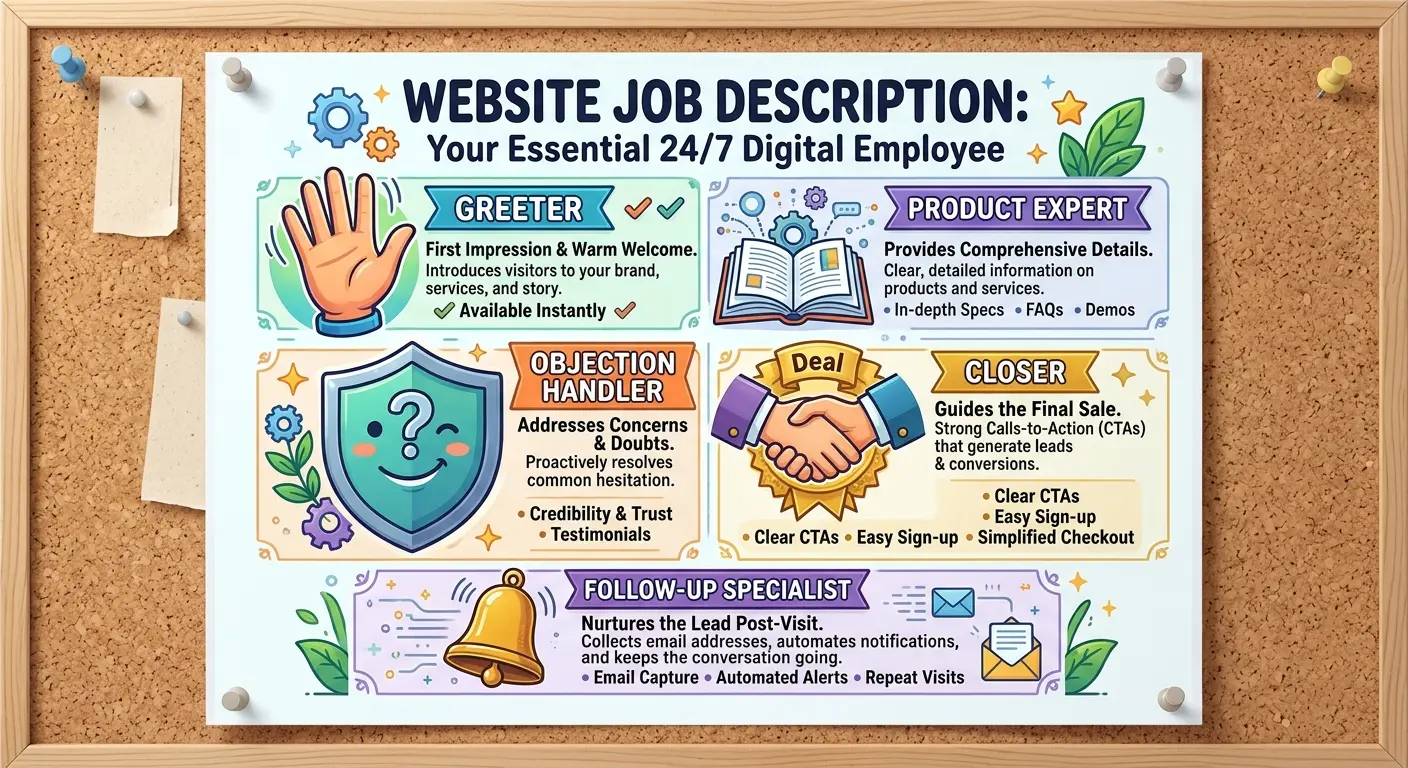
![A humorous illustration of a laptop wearing a name badge that says "Sales Rep," sitting at a desk with a mug of coffee, a clock showing 3:00 AM, and a stream of speech bubbles ("Quote?", "Delivery?", "Price?") floating in from a smartphone. A sleeping business owner is visible in a bed in the background with a smile. Warm, night-time colors with a glowing screen.]](https://res.cloudinary.com/dyhe1skhk/image/upload/v1793526975/ifukkvx2os8pljldnt4i.webp)
Let's say you want to hire a salesperson. You would write a job description, wouldn't you? Responsibilities, working hours, targets, and a line about "must be a team player."
Now think about your website. Most business owners hire one without ever writing its job description. Then they act surprised when it sits in the corner doing nothing, like a very expensive plant.
This post is about fixing that. A website can work around the clock, but only if you tell it what to do. So let's write the job description.
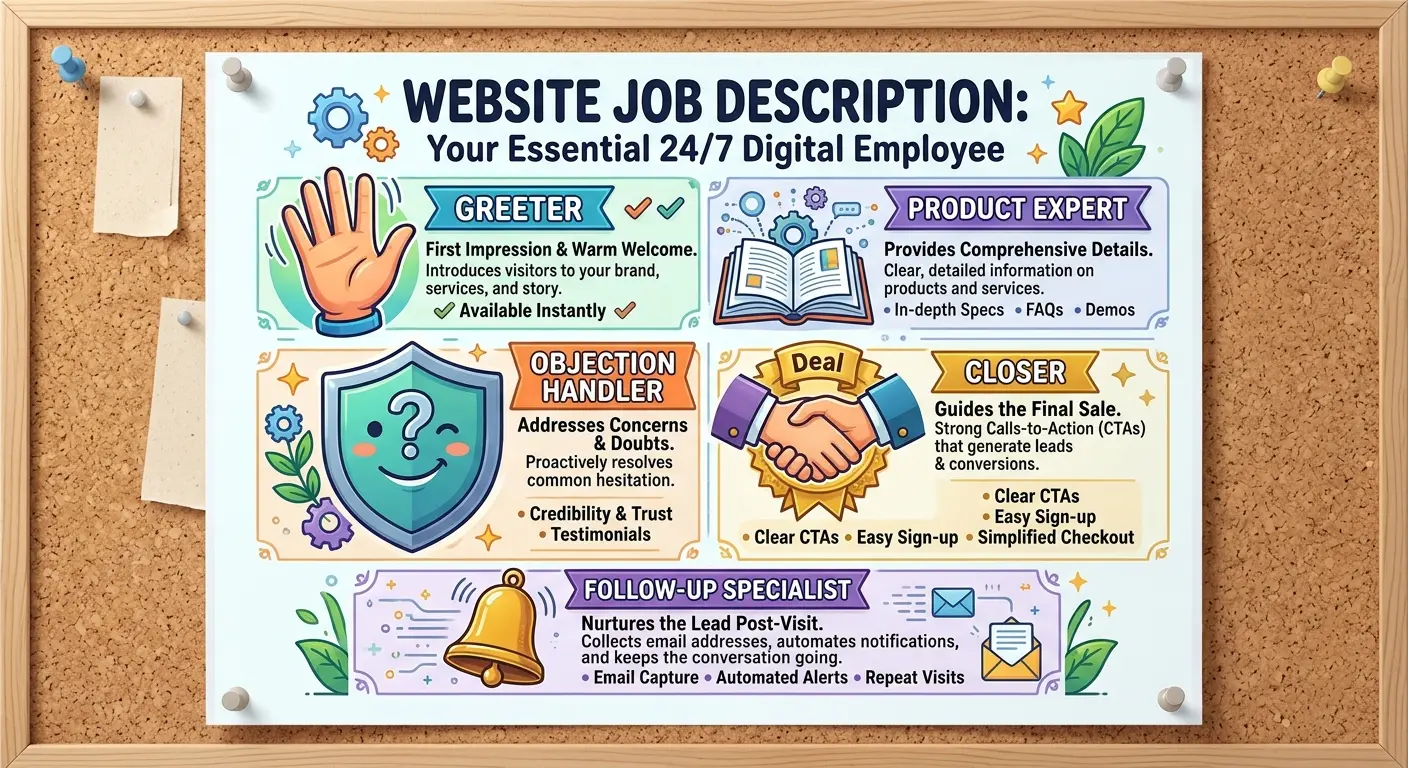
The Posting: One Position, Five Jobs
Here is what a website that sells for you must actually do. Notice how none of these jobs mention "looking pretty." Looks help, but sales reps are paid for results.
Job 1: The Greeter (first five seconds)
A visitor arrives and silently asks three questions: Am I in the right place? What do you do? What should I do next? If your homepage cannot answer these within five seconds, you have a greeter who stands at the door staring at his shoes.
Fix it with a headline that says what you sell and who it is for, one supporting sentence, and one clear button. "Welcome to our website" is not a headline. It is a doormat.
Job 2: The Product Expert
Your rep must answer questions without sighing. That means clear service descriptions, real photos, and plain-language details: what is included, how it works, and how long it takes. Customers who understand your offer do not need to phone you at 9 PM to ask basic questions.
Job 3: The Objection Handler
This is where Zambian buyers are different, and where most websites quietly lose money. People here have heard enough stories about online sellers who take payment and vanish. Your rep needs to defuse that fear before it is spoken.
Answer the unspoken questions right on the page:
"Is this business real?" Show your physical address, phone number, and photos of your premises or team.
"Will I get what I paid for?" Explain delivery areas, timelines, and returns plainly.
"Is my payment safe?" Display the payment methods you accept and mention your security certificate.
"Can others vouch for you?" Put real testimonials and client names near your buttons.
Trust is also tied to ownership and security, which I explore in how a website delivers ultimate business security.
Job 4: The Closer
A closer asks for the sale. On a website, that means one obvious next step per page: "Get a quote," "Book now," or "Order on WhatsApp." Three competing buttons confuse people, and confused people leave.
If your customers pay with mobile money, let them do it without a scavenger hunt. Every extra step between "I want this" and "paid" costs you customers. Fewer fields, fewer clicks, and a visible phone number for anyone who prefers to talk.
Job 5: The Follow-Up Specialist
The sale does not end when the button is clicked. Your website should reply instantly with a confirmation message: "Thanks, we have your request and will call you within two hours." That one automatic message tells the customer you are real, reliable, and paying attention.
A Day in the Life of Your Night Shift
Let's follow a customer named Mwansa (a made-up shopper, but you will recognize her). It is 11:40 PM. She has finally put the children to bed and is scrolling through her phone.
She searches for a service you offer. Your site loads quickly on her phone, the headline matches what she needs, and she scrolls to see your prices and reviews. She wonders about delivery, spots your FAQ, and finds the answer. She taps a button, fills out a short form, and receives an instant confirmation.
You were asleep for all of it. At 7:30 AM, you wake up to a message: a ready customer with a request. All you have to do is call back.
Now imagine the same customer finding a social media page with no prices, no clear contacts, and a comment section full of "DM for price." At midnight, nobody is there to answer. By morning, she has found someone else.
That is the entire business case for a 24/7 sales rep: it catches the customers who are ready to buy when you are not available.
The Boss Still Has a Job: Respond Fast
Here is a truth that surprises many owners. Your tireless website can collect a lead at 2 AM, but if you reply three days later, the lead has already gone elsewhere. A rep who never sleeps still needs a manager who does.
Set a simple rule: every enquiry gets a response within a few hours during business days. If you cannot do it yourself, assign someone and give them the phone. Speed of response is one of the cheapest competitive advantages you will ever find.
Four Numbers That Show Whether Your Rep Is Earning
You would not keep a salesperson without checking results. Track just four numbers once a month:
Visitors: how many people arrive.
Enquiries: how many contact you, call, or order.
Conversion rate: enquiries divided by visitors. If 500 people visit and 15 enquire, that is 3%.
Sales from enquiries: how many of those turn into paying customers.
Here is why this matters. Suppose your website attracts 500 visitors a month with a 3% conversion rate, giving 15 enquiries. If you close a third of them, that is five new customers. Now improve your page so conversion rises to 4%. That is 20 enquiries and nearly seven customers, without a single extra visitor. Small improvements in how well your rep sells can beat spending more to attract traffic.
When the numbers look weak, check the obvious suspects first: slow loading, unclear buttons, weak trust signals, or a form that asks for too much. My list of the 10 non-negotiable features every small business website in Zambia must have is a handy troubleshooting checklist.
Hiring Advice for the Digital Sales Rep
A sales rep is only as good as the person who trains it. When you brief a developer, don't just say, "Make me a nice website." Bring your five-job description and ask how each job will be handled: "How will this page greet visitors? Where will the trust signals go? What is the one button on each page?"
A good developer will welcome the questions. A great one will already have answers. If you want to understand how the full journey works, from idea to launch, my complete guide to web development services in Zambia lays out the whole map.
Time to Post the Vacancy
Your customers are already online, and many of them are awake while you sleep. The only question is whether something helpful is waiting to greet them.
Write the job description, brief your developer, and measure the results. And if you would like help turning your site into a real salesperson, take a look at the benefits of a professional website or book a free web consultation. Your night shift is ready to start. It just needs a manager with a plan.